
I. Printing Challenges and Market Demands for Nonwoven Substrates
Against the backdrop of the global nonwoven market being projected to reach a value of $58 billion by 2025 (data from Grand View Research), the medical and hygiene products sector commands more than 45% of the market share (China Industry Information Network). This rapid growth brings about rigorous demands on printing technologies. Water – based inks are required to meet the EN 29073 standard, which specifies a penetration depth of less than 30% of the substrate thickness. They must also achieve a dry friction resistance of at least grade 4 and a wet friction resistance of at least grade 3 as per the AATCC 8 – 2016 standard. Moreover, these inks need to comply with the ISO 10993 biocompatibility certification.
1.1 Technical Challenges Arising from Substrate Properties
Nonwovens are made up of randomly arranged porous fibers. This structure makes traditional inks highly likely to bleed and diffuse. Take SMS nonwoven (spunbond – meltblown – spunbond) as an instance. With a fiber diameter ranging from 20 to 50μm and a porosity of 70 – 80%, it is crucial to precisely control the ink penetration depth through the ink formulation. This is to prevent print – through, which can have a negative impact on the performance of the reverse side of the nonwoven.
1.2 Performance Requirements Driven by Application Scenarios
- Medical protective clothing: It should be able to endure more than 50 wipes with 75% ethanol, in line with the YY/T 1499 – 2016 standard.
- Baby diapers: They must pass the skin sensitization test as per ISO 10993 – 10.
- Automotive interiors: These products need to maintain their properties at a temperature of 150℃ for 2 hours, following the SAE J1885 standard.
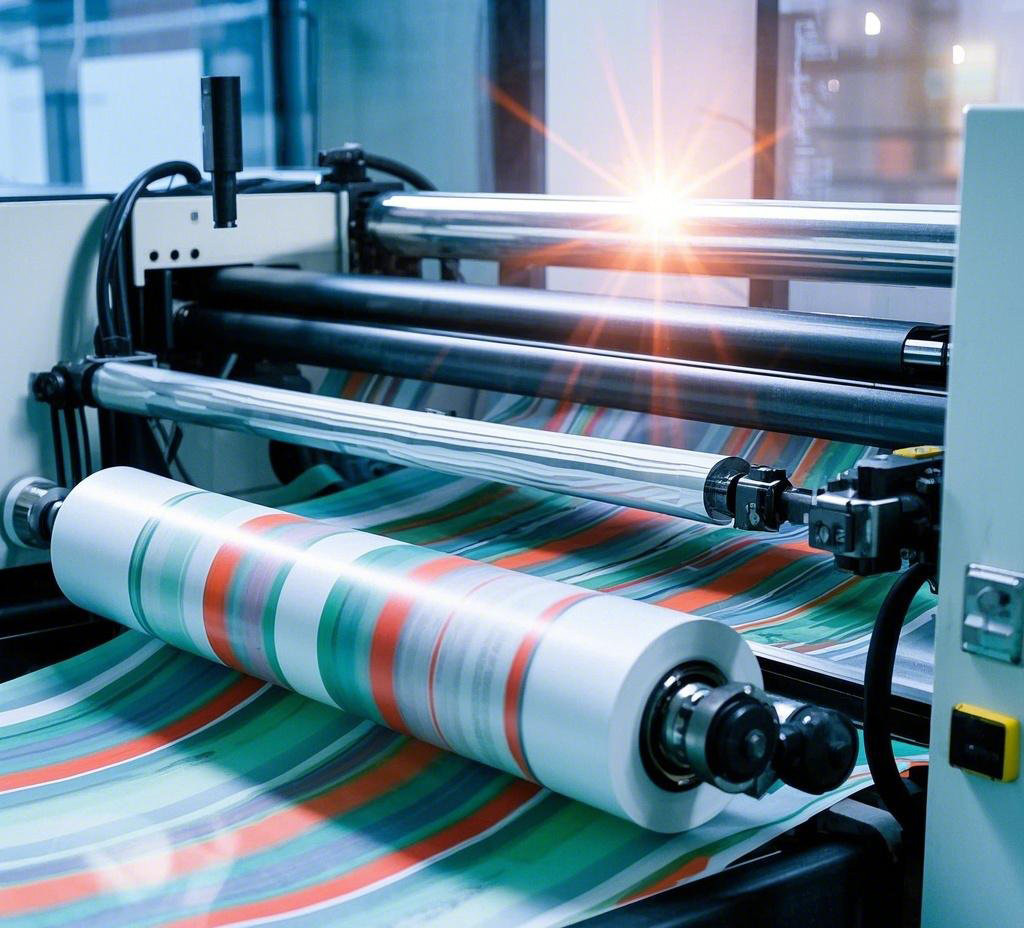
II. Formulation Structure of Specialized Water – Based Inks for Nonwovens
2.1 Design of the Resin Matrix
| Resin Type | Application Scenarios | Key Technical Indicators | Mechanism of Action |
|---|---|---|---|
| Styrene – Acrylic Emulsion | General hygiene materials | Glass transition temperature (Tg) = 25℃ | Forms a flexible film layer, where the Tg value determines the hardness and film – forming ability. |
| Polyurethane – Acrylic Hybrid | Medical protective clothing | Tensile elongation greater than 600% | Intermolecular hydrogen bonds enhance the material’s resistance to stretching. |
| Silicone – Modified Resin | Automotive interiors | Thermal stability at 150℃ | The siloxane bonds in the resin provide high – temperature resistance. |
2.2 Optimization of the Pigment System
2.2.1 Development of Functional Pigments
- Antibacterial inks: By incorporating 1.5 – 2% silver – loaded zirconium phosphate, these inks release Ag⁺ ions. These ions work by disrupting the cell membranes of microorganisms, as tested in accordance with JIS Z 2801.
- Flame – retardant inks: A blend of 60% aluminum hydroxide and 40% montmorillonite is used. When exposed to fire, this combination forms a heat – insulating carbon layer, resulting in an oxygen index greater than 28%.
2.2.2 Technical Matrix for Penetration Control
| Problem Type | Solution | Mechanism | Measured Results |
|---|---|---|---|
| Ink bleeding | Hydroxypropyl starch (HPS) | Forms a three – dimensional network barrier | The diffusion diameter is limited to 1.2mm or less, as per ASTM D3792. |
| Excessive print – through | Nano calcium carbonate (30 – 50nm) | Physically fills the pores in the nonwoven | The penetration depth is reduced to 22% of the substrate thickness. |
| Edge burrs | Polyether – modified polysiloxane | Reduces the dynamic surface tension to 28mN/m or lower | The edge clarity is improved by 40%. |
III. Strategies for Enhancing Printing Process Adaptability
3.1 Key Equipment Modifications
- Guide roller system: A ceramic coating with a friction coefficient of less than 0.15 is applied to the rollers. This helps to minimize damage to the fibers during the printing process.
- Drying module: A segmented hot – air design with a temperature gradient of 40℃→60℃→80℃ is implemented. This ensures that solvents evaporate in a controlled manner.
- Pressure control: A pneumatic compensation device is used to achieve a pressure accuracy of ±0.02MPa. This allows the printing process to adapt to fluctuations in the thickness of the nonwoven material.
3.2 Optimal Combination of Printing Parameters
| Process Parameter | Gravure Printing | Flexo Printing | Optimization Basis |
|---|---|---|---|
| Screen ruling | 120 – 150 lines per inch (lpi) | 800 – 1200 characters per inch (cpi) | Strikes a balance between print clarity and ink quantity control. |
| Ink viscosity | 18 – 22 seconds as measured by a Ford Cup 4 | 30 – 35 seconds as measured by a Ford Cup 4 | Adapts to the different mesh cavity structures of the printing plates. |
| Machine speed | 80 – 200 meters per minute (m/min) | 80 – 300 meters per minute (m/min) | Ensures that the drying efficiency keeps up with the printing speed. |
| Drying energy | 0.8 – 1.2 kilowatt – hours per kilogram (kW·h/kg) | 1.0 – 1.5 kilowatt – hours per kilogram (kW·h/kg) | Balances energy consumption and production capacity. |
3.3 Typical Application Case
After a medical protective clothing manufacturer switched to using water – based inks:
- The print – through rate was cut down from 12% to 3%.
- The friction resistance grade improved to 4.5 for dry friction and 3.5 for wet friction.
- The production energy consumption was reduced by 18%, according to the enterprise’s technical white paper.

IV. Environmental Certification and Industry Trends
4.1 International Certification Systems
- EU CE Certification: Ensures compliance with the REACH regulation’s SVHC list.
- USDA Certification: Requires that the bio – based content of the product is at least 30%.
- China GB 38468 – 2022: Sets a limit of 50 grams per liter (g/L) or less for the VOC content.
4.2 Technical Development Directions
- UV – curable water – based inks: Combine the advantages of UV curing technology with 100% solid content, enabling faster drying and lower energy consumption.
- Intelligent responsive inks: Thermochromic and humidity – sensitive inks are being developed for use in medical packaging to provide visual indicators.
- Circular economy design: Peelable inks are being explored to facilitate the recycling and reuse of nonwoven materials.
V. Conclusion
The technology of water – based inks for nonwoven printing is propelling the industry towards a more efficient, safe, and environmentally friendly future through resin innovation, pigment functionalization, and process optimization. As bio – based materials become more widespread and digital printing technology continues to advance, this field is expected to witness continuous breakthroughs. These developments will offer more competitive solutions for various industries, including medical, hygiene, and automotive sectors.
 StarColor Printing Ink
Leave a comment